

One of the most mysterious and exciting natural phenomenon, the Northern Lights, are on the bucket list of many travellers. People who already have seen the Aurora are raving how amazing it is. However, I have also heard some people saying how seeing the Northern Lights was nothing like they expected, that the colours were not as vivid as they have seen on the photographs and etc.
Recently a blogger has shared our photos (see below) on her IG story, saying that the display she witnessed was amazing but not what she expected and although she enjoyed it, I guess it left her wanting a bit more.
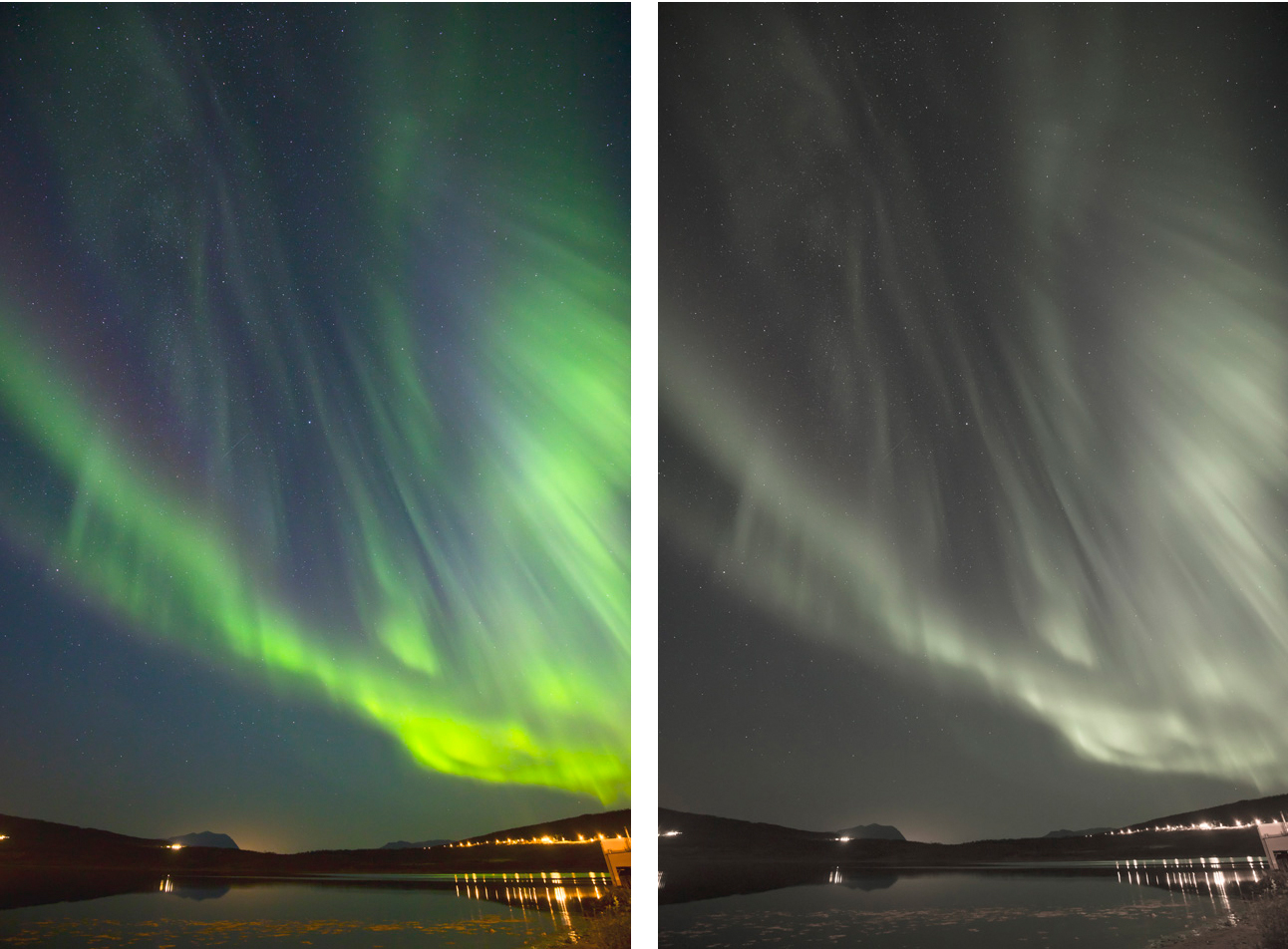
This inspired us to create a list of things to know about Northern Lights, break some myths and give tips so as a newbie Aurora chaser you know what to expect.
How to see the Northern Lights for the first time – a guide for a savvy traveller
TRUTH: Visit a country in Northern Hemisphere.
In Europe that would be Norway, Finland, Sweden, Russia, Iceland, Greenland, Scotland, Faro Islands; and then Canada or Alaska. The rule of thumb is the more north you go the more chances you will have to see northern lights. This however, does not mean that Aurora Borealis cannot be visible from any other European country, or another state in the USA.
TRUTH: Plan your trip between September and March.
From our experience the activity tends to be strong in September, December or March but again this does not mean that you won’t see the Lights in any other month.
You can see the Lights in August or in April if you are over the Arctic Circle or at high latitude. We enjoyed the Northern Lights in late August when visiting Lofoten or Senja islands.

TRUTH: Clear sky and darkness is not everything.
The most important factor is relatively strong solar activity, which is a result of explosions on the Sun of electromagnetic substance called coronal mass. The hurled charged particles, known as a ‘solar wind’, make their way towards Earth where they cause the display of Lights a few days later, when they enter Earth’s magnetic field.
The modern technology allows us to analyse when the Aurora may be active and how strong the activity appear to be, in real time. So follow a FB group with solar activity updates or use app such as Glendale or Aurora Watch UK to be alerted when the activity is strong and you are likely to see the Lights.
Note: When you are at high latitude, even week solar activity might produce a spectacular display of lights.
TRUTH: The show can start and finish very unexpectedly.
This is absolutely right. And what that means in practice is that the Lights may fade out and when you think that it is over for the night, some time later the show may start again. Usually that leads to staying out for most of the night, obviously you will not count hours as it is very exciting experience.
TRUTH: You do not need to spend a fortune to see Aurora.
Northern Lights tours are great because the tour operators know the area very well and have been chasing the Northern Lights for years, so they can find the best spots for potential viewing even when with cloud cover. Most tour operators offer for you to join a tour the next evening if you don’t see the Northern Lights. So do not book the tour for your last day, aim for the beginning of your trip.
However, if you are on a tight budget or guided tours are not your thing, you can still enjoy the spectacle. Actually many people just follow some important points we are talking about in this post and experience the Northern Lights independently!

TRUTH: You need to learn how to take photos prior the Aurora hunt.
Ela: I was incredibly excited to get the ‘red alert’ on my mobile app and hope that I will finally be able to see and photograph Northern Lights display. I had a rough idea how to prepare my photo gear and what settings to use, so quickly I grabbed the tripod and drove to the nearest viewpoint which I thought would be suitable. Having arrived I did not see anything with naked eye, although the activity was said to be strong. I set up the camera and took the first photo. It was a windy night so the photograph wasn’t perfectly sharp, but I definitely saw a green bow over horizon! Yay! I took several more photographs excited that I managed to capture ‘something’ and although only by the camera, but I saw Lady Aurora. I was beyond myself with happiness.
To tell the truth, the photographs I shot that night were totally spoilt. Blurry, grainy, uninteresting frames, Aurora hardly visible. (but nonetheless, it was my trophy, which I proudly presented to anyone who would look)
I won’t share these photos with you today, but can assure you that to take a decent photo of the Northern Lights you need some understanding of the conditions, for example find a spot sheltered from the wind. Know what to expect and understand that different levels of solar activity require different camera settings, of course you can always shoot Aurora on 30s but don’t expect the photos to reflect the dynamics of the ‘dance’.
Another thing you should know are the technical abilities of your camera, you have to be aware of its limitations, especially when it comes to high ISO image quality.
To recap, we all have expectations when it comes to seeing and capturing the Northern Lights. But the Lights are magical, elusive and unpredictable, capturing them requires a lot of preparations and learning. We prepared a guide for those who wish to learn the night photography and aspire to capture Aurora Borealis.
Maybe the first time you won’t take award winning images, but they may be mind-blowing for you due to their ‘sentimental value’. Every next time you will capture the lights better!
Important tip: If you had no time to learn how to take photographs of Aurora, just do not stress about it and enjoy the moment.
TRUTH: Seeing Northern Lights is one of the best experiences in life!
Seeing Northern Lights was our dream for long time and if you hear people saying it was one of their best experiences in life, they probably mean it. When we first time saw Aurora dancing above our heads we were weeping as it was so moving. The show lasted for a very long time and came very unexpected.
TRUTH: The higher the solar activity and the farther north you are the more vivid colours you will see with naked eye.
The colours – ohhhh this is our favourite Aurora topic of them all. Let start with a story. One year we stayed in a self-catering unit next to our host’s cottage on Isle of Skye, and on arrival we have mentioned that we hoped to see Northern Lights. Our host then responded that she has been living here her whole life and she has never seen the northern lights. Then on the Hogmanay when we were driving back from the party in town to our accommodation, we realised the Aurora was on. We rushed quickly to the Kilt Rock view point but it was very windy and cold and the lights were not strong, so we decided to go back to the accommodation. We were still hopeful and stayed outside for some time waiting. Further from the coast, the wind was calmer so we enjoyed the chat and waited. It paid off and we noticed the grey bows appearing in the sky. Very excited we run to our host and grabbed her outside. To our amusement, she was like: is that it? Why this is not green? I have seen the bows like that but thought it was clouds. Ela then took a couple of photographs and showed to her ‘the sky in colour’.
Lesson learnt – the Northern Lights can be vivid green or purple, but they also can be white or grey for the naked eye. Again, the higher the solar activity and the farther north you are the more vivid colours you will see with naked eye.


Northern lights seen thru clouds, and with full moon
MYTH: You cannot see Northern Lights during full moon or thru cloud cover.
Again, it all depends on the level of solar activity, when it is high you will be able to see the lights with naked eye without any problem. With strong lights in the sky you will be able to see and photograph them even thru the clouds! Even more, even some light pollution will not disturb your experience. With low activity and at lower altitude it would be reasonable to eliminate the light pollution as possible to have better experience.

MYTH: You need to look in the direction of north.
This is equally correct and incorrect. Over the Arctic Circle we literally had Aurora dancing above our heads, spread across the whole sky. It was really hard to keep the head up without feeling discomfort in the neck for that long. At lower altitude, definitely it is recommend to look towards north, as almost always the Northern Lights shows start from the north.
TIP: Always dress warmly. This sounds obvious, but dress like you mean it when going for an Aurora hunt. You may end up spending several hours outside. I would also recommend taking a flask with a hot drink.
Last point we want to make is do not plan the holiday just for watching the Aurora. Make sure to visit somewhere where you have plenty of activities and things you love to do and you can enjoy your trip. Northern Lights are not promised, but may be a fantastic bonus to your vocation!
When people see Aurora for the first time, some are already geared and some just see it by chance, but the common theme is that they all love the experience. And we love these stories as they are always interesting and full of worship and passion for the Northern Lights.
Hence we asked other bloggers and travellers to share their stories, and here they are.

Mike from LiveTravelTech
When I saw this northern lights travel blog collaboration I new it would be tough which solar storm to share. I live in Anchorage, Alaska and started photographing the aurora borealis 5 years ago. I first saw the northern lights in 2017 and could barely see them with the naked eye. Since then I’ve watched the aurora pulse directly above me as coronal displays shoot in every direction. I’ve since spent countless nights staring at the sky and put together timelapse videos of my favourite shows. On the best nights my wife and I lay down in the snow as the aurora danced from horizon to horizon. I’ve skied across a frozen lake while the aurora lighted my path and I carried a sled full of food, games and gear for the weekend.
The northern lights are a great hobby and borderline obsession of mine. I watch the kp indicator and astronomers 3-day forecast carefully from September to May and hope that they line up perfectly on a weekend night, but have been known to drive out on a school night too! The first time I took a photo of the aurora I was thrilled with the results, but didn’t realize how small of an aurora show I’d seen. My biggest advice to anyone looking for the aurora is to bring a lot of patience, layers, handwarmers and hot chocolate. But rest assured once you’ve seen a strong aurora show you’ll just want to see more. It can be quite addicting.
Thankfully I had a lot of practice with long exposure photography beforehand while dabbling in light painting, zoom burst and star trail photography. Even so, it took a few strong aurora shows before I was able to capture something that did justice to this natural phenomenon. During a strong event light pillars shoot down from the heavens while bright lights dance.
I’ve seen the lights from countless places around Alaska and even in my driveway in Anchorage. My favourite nights are at a cabin in Talkeetna or on a drive to the Knik River but I watched an amazing display for New Year Eve in Fairbanks too.
Janae from Adventures with TuckNae
We visited Iceland most recently in March of 2022. During our trip we were hopeful to see the Northern Lights even though it was late in the season. Before our trip we downloaded an app that would alert us of the current viewing conditions and alert us if the Aurora was likely to show up. During one of the peak evenings, we were staying in Vik, Iceland.
We decided to drive out of town to the designated viewing area to avoid light pollution. The problem was that everyone in that area had the same idea. The pull-off was extremely crowded with a range of considerate and very inconsiderate people. After sitting for a little while, we decided to drive further out on our own in hopes of finding a more quiet (and private) area to wait. We ended up driving up to the Dyrhólaey overlook.
Not only we were accompanied by fewer fellow enthusiasts, but we also had a much better viewing point! As we were parking we looked up and saw the Northern Lights and I got so excited!
We got out with our tripod and were able to photograph the beautiful greens and purples in the sky. The Aurora we saw was not as bright as some others have seen, but it was still beautiful and was one of the top highlights of our trip! If you’re visiting Iceland, I highly recommend adding this to your list of things to do near Vik, Iceland.

Theresa from Fueled By Wanderlust
My first time ever seeing the northern lights was on a guided tour out of Reykjavik, Iceland. This was the second attempt for my husband and I, after attempting the exact same tour with no luck three years earlier. The only difference was that this time we were visiting Iceland in January instead of October. We were hoping our chances would be better in January due to more overall hours of darkness.
When our trip finally came, once again the tour got cancelled for our first three nights due to cloud cover. Finally, on the last night of our trip, conditions were clear enough for the tour to run. As the forecast called for low activity, or a KP index rating of 1 out of 9, I kept my expectations low.
Our guide drove us to the lookout spot on a windy peninsula about forty minutes south of Reykjavik. Optimistically, I looked out the car window towards the sky behind me, and I saw an usual cloud on the horizon. It was wispy and seemingly in motion, but I thought for sure I was seeing things.
That’s when our guide motioned to come outside, as the dancing cloud was indeed an aurora. Immediately, our small group started taking photos, while the northern lights grew to three bands stretching across the sky. I could see the lights with my naked eye, though the green colour was pale compared to the bright shade on my camera screen. After thirty minutes, the lights faded away and clouds swept in, rendering our show over for the evening.
While I had ordered a tripod from our tour operator, they ended up forgetting to bring one for both me and themselves. Therefore, most of our photos turned out blurry, though the lights still look perfectly vibrant.

Andreea from Andoreia
Seeing the Aurora Borealis was hands down one of the best and most unforgettable travel experiences I’ve ever had. But before the trip, I did a lot of research, especially since I was planning to see the Northern Lights on a budget.
And this really paid off. I managed to witness the Aurora dancing in the sky on three consecutive nights out of the four I spent in a small village in the Swedish Lapland, called Abisko.
Not only that, but during two of these nights, there was a solar storm, so the Lights were brighter and more active and I could easily see them with the naked eye. And that was despite the adverse weather, as it was snowing.
But I do have to mention one fact: the Aurora wasn’t the saturated neon green that it appears on cameras. Or at least it wasn’t for me. While I could easily see the pinks, the green was a lot more muted in real life than it actually looks in pictures. I do wonder if it was because of my lenses (I have myopia) since a friend said she could see bright green hues as well during the peak of the solar storms.
As for the success in seeing the Northern Lights, I credit it both to the location (Abisko has clearer nights than other popular Aurora destinations), as well as to the time frame that I chose: I went to the Arctic Circle in March, around the Equinox, when the solar activity is said to intensify.

Kenny from Knycx Journeying
I visited Yellowknife in late October and the city was already covered in snow. Yellowknife was one of my best experiences in northern light viewing, and that’s why this is one of the best places in the world that I recommend for such activities.
Yellowknife is located in Canada’s Northwest Territories and it is the capital city with only 20,000 inhabitants. For decades, Yellowknife has been a popular destination for northern lights and winter activities – and so it has all the facilities and businesses that made our trip a fairly easy one. I planned a week-long northern light viewing trip in Yellowknife to make sure I had the best viewing. In fact, due to its high latitude, long winter, clear sky, and remoteness, Yellowknife enjoys minimal light pollution and wonderful sky conditions, usually, visitors have a 90 percent chance of sightings during the season between mid-October and March.
It turned out we saw our first northern lights right outside our hotel window the same day we landed and checked in at 7 pm. I had also signed up for a local tour the same night, in which the experienced guide had shared valuable advice, and help take photographs with their professional camera and night photography skills. The Aurora village has cozy facilities and we found a spot at the top of a hill we spotted the dancing northern lights straddling the horizon from one side to the other. The wonderful thing about seeing the lights in a village is that you share the excitement with strangers as everyone is ooo-ing and huh-ing at the same time like watching the fireworks.
After a few nights of watching the lights with guided tours, it is possible to rent a car and explore the area. There are so many places in Yellowknife to explore and we had a few more sightings in different places and different settings for the rest of the week.

Megan from Megan Starr
There are so many places around the world to view the northern lights but one of the most famous in Europe is Tromsø, Norway. I have been to Tromsø multiple times and have seen the midnight sun there but there is simply nothing like watching the aurora! The best time to see the northern lights in Tromsø is during shoulder season but you can also get a good glimpse during the winter.
My first northern lights experience in Tromsø was in early December and I was visiting with my partner. We actually had arrived and had no tours booked for the first night and I randomly peeked outside and saw the northern lights dancing over the city. I knew what the lights looked like so I knew what to look out for, but I was not expecting to see them so clearly in the middle of a city brimming with light pollution. While I saw them with my own eyes, the colour was enhanced by my camera.
While this was not my first time seeing the northern lights, I am (still) no expert at photographing them! My photos from that unexpected experience turned out horribly! The lights danced over the city for a few hours that night and it was such a nice introduction to the Northern Norwegian city!
Seeing the northern lights without a tour was a great experience, but I do highly recommend booking a northern lights tour in Tromsø, if you have never seen them before. I joined two northern lights tours throughout the rest of my time in Tromsø and they take you far outside of the city to places with open skies and no light pollution, making the experience far better!

Catherine from Nomadicated
Just north of Husavik, Iceland, the steam rose into the peaceful, star-studded sky from Ostakarið hot tubs, a local’s hot spring we were soaking in. As we relaxed, strange spots started forming in the clear sky, unlike any clouds I had ever seen. Little did we know these would be the first hints of my first northern lights experience.
In February 2018, my boyfriend and I rented a car for two weeks to drive the entirety of Iceland’s iconic ring road. We hoped to tick one of my bucket list ideas – to see the northern lights.
Day after day, this phenomenon eluded us as we drove from the northwest to the northeast, knowing our chances would diminish as we began to head south. But on one of our final nights in the north, it finally happened.
As the strange patches in the sky formed, their grayish tints began to shift into greenish hues before we realized what was going on. We jumped out of the pool into the freezing air, adrenaline pumping, to drive to the darkest nearby area to avoid any light pollution.
We made several stops before finally resting 14 miles away from our original location, where a lake met the foothills of nearby mountains. My heart pounded as I watched the display of light dance across the sky, and clicked away endlessly from my camera, hoping to preserve the beauty in front of me.
Just as quickly as it came, the distinctive green dimmed within the hour and finally disappeared back into the night sky.

Marianne from The Journeying Giordanos
The very first time my family and I saw the Northern Lights was a serendipitous and magical experience. We were road-tripping through Alberta for the Canadian Thanksgiving weekend in October, and were totally not expecting to see the famous “Aurora.”
We were staying in the town of Jasper, located in Jasper National Park. And for those who may not know, Jasper National Park is one of 17 designated Dark Sky Preserves in Canada.
Jasper is also the second largest Dark Sky Preserve in the world, and the largest accessible Dark Sky Preserve – meaning there’s a town located within the limits of the preserve.
After going out for a late dinner, we happened to notice some strange white lights swirling across the sky. Confused, we weren’t quite certain what we were seeing.
So we hopped into the car, and within a couple of minutes, we were outside the town limits, parked in a dark lot. It was then we noticed that along with subtle white lights, swirls of green were also dancing across the skies. The Northern Lights!
It was incredible! Although I was a little disappointed that there were no purples or pinks visible, we were blown away by the jaw-dropping display.
After about an hour, we made our way back into town and were surprised that we could still see the vivid green splashes in the sky. I only wish that I would have had my DSLR with me, but my iPhone actually did an OK job capturing the images!
We came across many locals who were also out enjoying the display. They advised that it was pretty rare to see the Auroras this early in the season and that we were pretty lucky with how intense the colours were.
We probably stayed out in the cold for over three hours, not being able to tear ourselves away from the incredible show that Mother Nature was putting on for us. Definitely, an unforgettable moment that I was happy to be sharing with my family.
Nicole from Go Far Grow Close
In February, my husband and I went to Whitehorse in the Yukon Territory in Canada to see the Northern Lights. We stayed at Inn On The Lake, about a 40 minute drive from the Whitehorse airport. They offer a three day/four night full package which includes all meals, a dog sledding experience, a snowmobiling and ice fishing excursion, and the ability to see the Northern Lights from the comfort of your own room, in some cases, or right outside.
Prior to booking, we knew that February would be a good time to try and see the Northern Lights. In addition, we picked a weekend when the moon would be at its smallest to reduce any glare from the moon.
The Inn staff recommended that we download a couple of apps that help to predict the likelihood of seeing the lights each night, and at what times.
Each night, I barely slept, waking myself as often as I could. The first two nights, I did not spot any. However, we were in luck on the third night.
We only saw them in white but they were easily seen for over a couple of hours. They danced and moved. It was absolutely stunning and mesmerizing to watch, even without other colours.
I raised my camera to see whether there would be a decent photo, and decided that there would not be. It was just too dark and without perspective. So, I didn’t even try and take a shot.
I absolutely loved seeing the Northern Lights. I would have happily stayed up the whole night to watch them if they had lasted. The snowy winter wonderland combined with the shimmering white lights in the night sky made this an unforgettable experience.

Bella from Passport and Pixels
Most people do a huge amount of planning to see the Northern Lights, but the first time I saw them was almost by accident. I was in Iceland in late January for a work trip, staying in a remote hotel near the black sand beach at Vik, and although I was aware there might be Aurora, seeing them was not high on my agenda.
It was my birthday, and after a single celebratory G&T in the hotel bar, exhausted after a long workday, I went to bed. I was half asleep when someone from the hotel came knocking on everyone’s doors, excitably shouting ‘Northern Lights! Northern Lights are out!’
Half asleep, I struggled out of bed and stumbled out into the corridor, blindly following the trail of other guests heading out into the icy night. It was only when I’d skated over the frozen car park and up a nearby hill that I realised I’d failed to bring either a coat or my camera. But there they were, my first Aurora, glowing bright green in the sky. I watched for a bit, and thought about going back to get my gear, but in the end I was too tired and cold so I went back to bed.
In the days that followed, though, I had regrets. Why hadn’t I taken a coat and my camera? Had I missed my only opportunity?! But I still had a chance. I had a couple of days sightseeing after work ended, and I’d booked a 2-day trip to the Snaefellsnes peninsula. On the second night, just as we were heading back to the city, the guide announced that there would be Aurora activity that evening. We pulled over at a rest stop, grabbed a quick dinner, and waited. And miraculously, my luck held out – with a spectacular display so bright it could be seen in the UK. As first photography attempts go, I was pretty happy, though now I’m determined to go back and try to capture them again in a setting slightly more scenic than a roadside car park!
