

Wow you’re planning a road trip to Orkney, the amazing islands that will take your breath away, we know the feeling very well!
Despite being passionate about mountains and hiking in high places, we headed to Orkney and were never disappointed. Although the islands mostly feature gentle rolling hills, we easily fell in love with the community spirit, relaxed atmosphere and very friendly locals (on top of the obvious, like stunning nature and rich historical heritage).
Orkney islands, usually referred to as Orkney, is an archipelago located only 8 miles north from Scottish mainland. On a clear day the islands are visible from Thurso and John O’Groats area, and they’re connected with the ‘tip of Scotland’ by a regular ferry service. The islands are a very popular destination for road tripping! They’re a true gem in Scottish crown and home to UNESCO World Heritage Sites!
We have visited the Orkney during a 1 week road trip from Edinburgh and were completely enchanted not only by picturesque scenery and unique monuments, but also by islands’ history and culture. Indeed, the Orkney are spectacular in many ways and will leave you speechless many times over!
The archipelago is a go-to place for learning about Scottish Viking culture, Neolithic sites, as well as WWII monuments. To fully enjoy the Orkney experience you have to keep your heart and eyes open, as the small islands will surprise you in so many ways, there’s no end to Orkney treasures!
If you’re visiting the archipelago to learn more about the Vikings who ruled them from 8th to 13th century, you can’t miss these:
- Magnus Cathedral in Kirkwall
- Brough of Birsay
- Earl’s Bu and Round Kirk /Orphir
- Orkneyinga Saga
- Broch of Gurness
- Maeshowe Chambered Cairn
- The Gloup and Mull Head with Brough of Deerness
If you’re mostly interested in wartime landmarks, don’t miss these:
- Churchill barriers
- Italian Chapel
- Scapa Flow Museum
- Hackness Martello Tower and Battery
- Flotta Heritage Centra
The most important Neolithic and UNESCO world heritage sites:
- Ring of Brodgar
- Standing Stones of Stenness
- Barnhouse Settlement
- Skara Brae
- Maeshowe Chambered Cairn
Apart from the main sights, we’ll also help you find travel information, like ferry booking website and how to get to and around Orkney islands by public transport (if you’re coming without a car)
We visited Orkney in autumn and, besides historic monuments, we were keen to explore Orkney’s nature and connect with local community. Below we’re sharing our 7 day Orkney itinerary, check out how we did it!
We believe that the photographs alone will inspire you to visit Orkney!
Road trip to Orkney – your EPIC 7 day itinerary!

Day 1:
Tomb of the Eagles
Italian Chapel
Churchill Barriers
Day 2:
Ring of Brodgar
Standing Stones of Stennes
Barnhouse settlement
Maeshowe Chambered Cairn
Day 3:
Mull Head and The Gloup
Taracliff/Skaill Beach
Day 4:
Kirkwall
Highland Park Distllery
Scapa Distillery
Day 5:
Hoy island and the hike to the Old Man of Hoy sea stack
Day 6:
Return from Hoy
Earl’s Bu near Orphir
Skara Brae
Day 7:
Yesnaby castle
Brough of Birsay
Broch of Gurness
How to get to Orkney
Orkney islands can be reached by ferry operated by Northlink (book online) (crossing time approximately 1,5 hrs).
There are two routes between Scottish mainland and Orkney: Gills Bay to St.Margaret’s Hope and Scrabster to Stromness, so you can pick a more convenient sailing and destination, depending on your accommodation and plans!
For our trip we sailed from Gills Bay to St. Margaret’s Hope to get to Orkney, and from Stromness to Scrabster on our return.
Otherwise, non-motorists, can reach Orkney by plane to Kirkwall (service operated by Scottish provider, Loganair, from Edinburgh, Glasgow, Aberdeen, Inverness, Fair Isle), however, please note that for the purpose of this article we assume that you’ll have your own means of transport for this ‘road trip’.
If coming by air, the most convenient would be renting a car at Kirkwall airport.
Getting around Orkney for non-motorists
The islands have public transport service operated by Stagecoach, the local lines (approximately 10 routes) serve all main attractions!

The 7 day Orkney itinerary
Let’s start from having a look at the location of main attractions and points of interest! The above simple map will help you plan the trip or tweak our itinerary, if necessary. We prepared the EPIC 7 day Orkney Itinerary considering the locations of landmarks and grouping them in a way that ensures as little travel as possible, to be more environmental friendly and avoid creating unwanted traffic, rather than driving erratically across the islands!
DAY 1, arrival to Orkney and visiting wartime monuments
Depending on your arrival time and destination (St. Margaret’s Hope or Stromness) you may not be able to check out all recommended sights of day 1 (in this case add them to other days, based on the theme or location on Orkney Mainland)
TOMB OF THE EAGLES
This Neolithic site is also known as Isbister Chambered Cairn, discovered in 1958 is one of Orkney’s most important archaeological sites. Excavated chamber presented countless bones and artefacts, most of them 5000 years old! Learn about daily life of Bronze Age and Stone Age people! A visit to the Tomb of Eagles includes a 1 mile walk from the visitor centre to the tomb itself, along a marked wildflower trail with sea views.
You probably wonder where the name came from? The chambered cairn was used as a tomb, archaeologists found remains of 30 humans together with bones of 14 white-tailed eagles! Hence the name ‘Tomb Of The Eagles’! This raised questions about the relationship between Neolithic people and these majestic birds of prey.
Keep in mind that visiting the chambered cairn requires a short traverse of a 3 metre passageway (70 x 85 cm) which you can just crawl or use a simple trolley to get in. If you struggle with small spaces, we recommend reversing thru the passageway while watching the seafront, rather than entering head first!

ITALIAN CHAPEL
Located on the tiny island Lamb Holm this small Catholic Chapel is a true gem. Not only it’s a beautiful monument, but its history makes it even more special! The chapel was constructed by Italian POW (prisoners of war) who resided in a camp located on the island from 1942. The soldiers insisted they needed a place of worship and subsequently got a permission to build a simple chapel. Despite its modest outside appearance the Italian Chapel will awe you as soon as you step inside. The elaborate ornaments and beautiful 3D paintings would easily fool you; you may as well be in an old chapel built of stone somewhere in southern Europe. Such was the kunst and creativity of imprisoned soldiers, who as it happened were also artists! Having only simple tools and concrete to work with, the camp residents created one of the most beautiful and loved chapels in Scotland, a very special place of worship, still in use!
As the war ended and the prisoners were sent back home, the chapel wasn’t finished and some soldiers offered to stay behind to complete the chapel, one of them Domenico Chiocchetti, the man who’s painting talent can be admired inside the Chapel. The history gets even more interesting when, after the war, many POWs came back to re-visit Lamb Holm and the chapel with their families!
If you’d like to find out more about Italian Chapel and its fascinating history, we recommend reading a book ‘Italian Chapel’ by Philip Paris (fiction based on historic facts). You’ll be awed!


CHURCHILL BARRIERS
The very same prisoners of war who built Italian Chapel, were also constructing causeways (known as Churchill Barriers) between Orkney small islands. Although the barriers’ main aim was to prevent German warships and boats from sailing freely in waters of Scapa Flow, officially the barriers were constructed as ‘causeways’ to help the community moving between the islands. By law, the prisoners of war could not be used to build military defences nor military purpose constructions, hence the ‘causeways’, which were finally recognised for what they were (barriers), after the war.
4 barriers were built to prevent access to Scapa Flow, they are still in use nowadays, as the causeways. You’re most likely to drive thru some of them during your visit to Orkney, but the best view to see over the barriers is from road B9052 up the hill from Graemeshall. To see the causeways up close it’s best to park at the free car park near St.Mary’s and have a short walk, mindful of motor traffic!
DAY 2, Neolitic treasures with a Viking twist
On the second day of the road trip to Orkney, we’re taking you to visit some of the treasures of Orkney Neolithic heritage, the ancient rings of stones and pre-historic settlements, all conveniently located only a short distance from each other on Orkney Mainland. Keep in mind that these are outdoor attractions under protection, only walk on prepared walkways and respect boundaries and barriers.

RING OF BRODGAR
This impressive ring of stones dates back to 2500 years BC. Originally it contained 60 slabs brought from all over Orkney islands, however only 27 remain in place today. Reason behind erecting this incredible ring of stones is still unclear, however it is usually believed that the ring was built for astronomical reasons, or alternatively, as a shrine where rituals were performed. Together with other attractions we recommend for day 2, the Ring of Brodgar is in the very heart of Neolithic Orkney, and in 1999 was awarded an UNESCO World Heritage Site status. Indeed, the award means increased touristic traffic (even bus tours from cruiser ships that come to Kirkwall!), therefore we’re really keen to make you aware of the monument’s significance and importance. When visiting Ring of Brodgar, please keep to the constructed paths only and refrain from touching the rock slabs. Never leave your mark on these ancient megaliths! Yes, you will be able to see many ‘scars’ on the stones, including graffiti and carved names of discoverers, but treat them as a historical quirk.

STANDING STONES OF STENNESS
Less than a kilometre away from the legendary Ring of Brodgar is a smaller ring of stones, known as Stones of Stenness. Despite being smaller, the ring is created of slabs just as grand as its famous sibling! Stones of Stenness are massive reddish slabs carefully erected on a croft (of course, this land wasn’t a croft at the time of construction). Nonetheless, you’re very likely to come across friendly sheep while strolling among the megaliths! Ensure to take care when interacting with livestock, keep your dog on lead at all times. We can’t help but wonder, what was the reason behind erecting rings of stones in this particular location… Having two such monuments in proximity of less than 1 km can’t be a coincidence!

BARNHOUSE SETTLEMENT
Only a short walk from the Stones of Stennes is another interesting Neolithic site, Barnhouse Settlement (or village). To find it, we recommend walking 150 metres past the ring of stones, toward the loch shore. Located at the quiet shores of Loch of Harray, this site is incredibly interesting as it includes remains of at least 15 dwellings, not unlike these at Skara Brae. The excavations unearthed tools and everyday objects as well as mysterious stone which is believed to have originated from Isle of Arran (just at the other end of Scotland!), incredible! Houses of the Barnhouse settlement were round and probably roofed with wood or turf, but there were no roofed passageways between the individual houses. The greatest mystery of Barnhouse Village is the fact that the dwellings seem to have been purposefully demolished at the end of their life. You may think that despite being similar to settlement at Skara Brae, Barnhouse was not as developed and does not seem to be as advanced. Well, it is believed that Barnhouse was out of use some 450 years before Skara Brae, and it’s the main reason behind it’s under development in comparison to the other Neolithic site.
MAESHOWE CHAMBERED CAIRN
The Chambered Cairn of Maeshowe was built to serve as a tomb. In shape, the Cairn reminds a small hill, with a entrance passageway on the western side. The entrance was aligned with midwinter setting sun to illuminate the cairn’s interior via the narrow passage. Maeshowe Cairn is the ‘Viking twist’ of day 2! In XII century Norse crusaders broke into the cairn (which was already 3000 years old at that time) and carved runes all over its walls! Both the cairn and the runes are important historical artefacts nowadays. You can only access the cairn on a guided tour (approx 1 hour) where you will be made familiar with most interesting facts related to the cairn, and will see the Norse runes up close, even have some translated for you (please remember that photography is not allowed inside the chamber)! We highly recommend visiting this amazing historical site, it’s well worth the admission charge!
DAY 3, Orkney’s stunning nature!
OK, so far you’ve discovered some of Orkney’s mind-blowing Neolithic sites, as well as unique wartime monuments. It’s high time to explore some nature trails! Orkney’s landscape may not be the most dramatic, but a keen eye will find islands’ coastline rather interesting, with several stunning cliff areas and other curiosities! The day 3 of our epic Orkney itinerary will take you to a far-off side of Orkney mainland, the easternmost corner, known as the Deerness.
Deerness is home to Mull Head Nature Reserve and the Gloup. The later is a unique landmark, a collapsed sea case, in fact the word ‘gloup’ means ‘collapsed sea cave’ and comes from Old Norse. Yet another unexpected Viking twist on your Orkney road trip! Not that far from the nature reserve is a stunning sandy beach, at Taracliff. We are taking you to explore this beautiful location as well!
THE GLOUP AND MULL HEAD NATURE RESERVE

To find the Gloup, follow road A960 east, and continue further as the road number changes to A950. You’ll drive thru serene rural scenery with farms scattered on small rolling hills. We recommend visiting the Gloup together with Mull Head Nature reserve, hence the best spot to start this easy hike is the dedicated Mull Head car park (directions).
Conveniently, the car park is only a short walk away from the Gloup, the first destination along the trail.
To fully enjoy the nature of Mull Head Reserve, we recommend a 6.5 km circular walk, which should take no more than 2.5 hours to complete. This easy walk is mostly flat as it follows coastal paths and farm roads, but be aware that you need good walking boots to explore some of its hidden gems, like the Brough of Deerness (more info further in the text).
Why is the Gloup so special? You can actually see the collapsed sea cave (mind the drop!) and listen to waves crushing below you, in the cave corridor, now exposed. Also, as a small stream brings water from surrounding meadows, there’s a tiny waterfall that drops at the far end of the Gloup. The collapsed part of cave is a chasm, but the ground is not collapsed along the whole length of the cave, with about 100 metres passage nearer the coastline.
Those interested in geology and natural history can enter the Gloup from the sea, on a small boat or a kayak, but it’s not recommended to inexperienced visitors, after all the sea around Orkney is rather wild!
Finding the Gloup is easy, simply follow a signposted trail from the car park; having passed the Gloup continue along the trail that sticks to the coastline. Mind the loose rock and slippery stones as you come closer to the cliff edge!

Past The Gloup, follow a clifftop path to enjoy seaview and reach Mull Head. Less than a kilometre from The Gloup you’ll come to another interesting feature of local landscape, Brough of Deerness. It can simply be described as a near-detached head land, at high tide it can seem to be an island just off the coast. The Brough can be accessed via a passageway with steps sculpted in the rock and secured with chains, then a mildly exposed narrow path (also secured with chain). You should not skip a short visit to Brough of Deerness, give it a go, if you find the passage too difficult you can always turn back and stick to the coastal path leading to Mull Head.
It heavily rained during our visit to Deerness area, but we still ventured to explore the hidden gems and spots along the mull Head coast. Despite the weather, the rocky cliffs appeared dramatic rather than dull, the inconvenience being mostly related to slippery wet rock and muddy path (very wet in places!), but it’s not unusual in Scotland!
Below we’re sharing several photographs taken along the way to Mull Head, to convince you that this far corner of Orkney mainland is well worth a visit, and to give you insight what to expect along the walk even on a rainy day!
If you’re visiting Mull Head and the Deerness in the spring, you may want to gear yourself with binoculars and try seabird spotting! Mull Head is a known Puffin breeding location! Enjoy!
Seabirds aside, look out for black buffalo casually grazing along the Deerness coast.
TARACLIFF / SKAILL BEACH
Only a short drive from Mull Head car park and visitor centre is Taracliff Bay, home to a beautiful sandy beach. As sandy beaches are not a common sight on Orkney, you shouldn’t skip this one!
The car park is located along main road A960 and you’ll be able to see the beach while driving the narrow stripe between Taracliff and Sanday bay, don’t hesitate to stop and explore!

With a bit of luck you may be able to spot a whale in the bay, it’s not uncommon for an odd whale to get stranded on Taracliff beach! The bay is unsheltered hence it can be a windy place, remember to dress properly for a beach walk. Indeed, you’ve just visited Mull Head and walked for a couple of hours, but listening to waves gently washing a sandy beach is a totally different, a very calming experience!
On a calm evening you’ll also have a chance to admire mirror-like waters of Sanday bay, with rolling hills and farms reflected in golden water, with view to the northern corners of mainland Orkney, far over the horizon.
DAY 4, Kirkwall and the distilleries!
A road trip in Orkney would not be complete without a visit to the capital, Kirkwall. To be totally honest, Kirkwall is the largest town in Orkney, and home to the archilepago’s tallest tree as well as 12th century Norse cathedral of St. Magnus. In Kirkwall, yet again we witness how islands’ history is entangled with Vikings’. The name Kirkwall comes from Old Norse (church on the bay) and was erected while the Vikings were at home in Orkney. Other interesting facts about Kirkwall include the fact that Kirkwall High Street is an official the most beautiful High Street in Scotland.
Two distilleries are located in the vicinity of Kirkwall, we’re sharing information about both of them below.
But since we’re in town, we can’t be quiet about its magnificent cathedral, erected in Viking times and rich in Viking theme ornaments. St. Magnus cathedral is unmissable! The majestic church can be found in the heart of Kirkwall, and it’s impossible to overlook. We strongly encourage you to step inside and see this amazing place of worship (as well as an important historical monument) for yourselves.

ST. MAGNUS CATHEDRAL
The cathedral was founded in 12th century and took some 300 years to complete. It is dedicated to Magnus Erlendsson, Earl of Orkney, a martyr from his cousin’s hand. The cathedral is the only church in Scotland known to hold the bones of its original saint. Although you can visit the church on your own, we recommend taking a guided tour, to access the upper parts of the temple and hidden passages and staircases.
For us, personally, one of the most beautiful ornament of the cathedral were the tiled floors (.. and stained glass, and wood carvings…), so unlike anywhere else in Scotland!

Another unmissable sight in Kirkwall is the tallest tree on Orkney, at Albert Street in the heart of old town. Although this particular tree is ‘THE TREE’ in Orkney, you can find more trees near the cathedral, or on Hoy island (woodland on Hoy is the northernmost natural woodland in the UK!)

HIGHLAND PARK DISTILLERY
Highland Park is less than 30 mins walk from Kirkwall town centre, just over 1 mile in distance!
By far, Highland Park is the most recognisable distillery in Orkney! We can’t recommend the distillery tour enough! Even if you’ve already visited other whisky distilleries in Scotland, you should still book a tour at Highland Park!
The tours are tailored to suit your ‘whisky knowledge’ with various packages of visiting/tasting. During our visit we opted for the shortest and the cheapest guided tour with tasting of 2 Highland Park whiskies. For us, the visit was very informative and interesting, we learned a lot about whisky production, and thoroughly enjoyed the two wee drams we tasted! In fact, we took home a nice bottle of 10 year old Viking Scars whisky (our favourite), and tried other flavours/themes since (we especially recommend the very smoky Dragon Legend edition too!). The Highland Park whisky is beautifully bottled, and would make a great souvenir from your Orkney road trip!
As the distillery tours are very popular, make sure to book your visit in advance, to avoid disappointment!
SCAPA DISTILLERY
Highland Park is the most famous, but not the only distillery in Orkney. Scapa is located only a couple of miles south from Kirkwall, hence easily accessible as well! Despite being lesser known, it does not lack quality! Scapa distillery also offers tours with whisky tasting, so if you missed on Highland Park you may want to book Scapa.
DAY 5, Trip to Hoy island and a hike to the Old Man of Hoy sea stack!
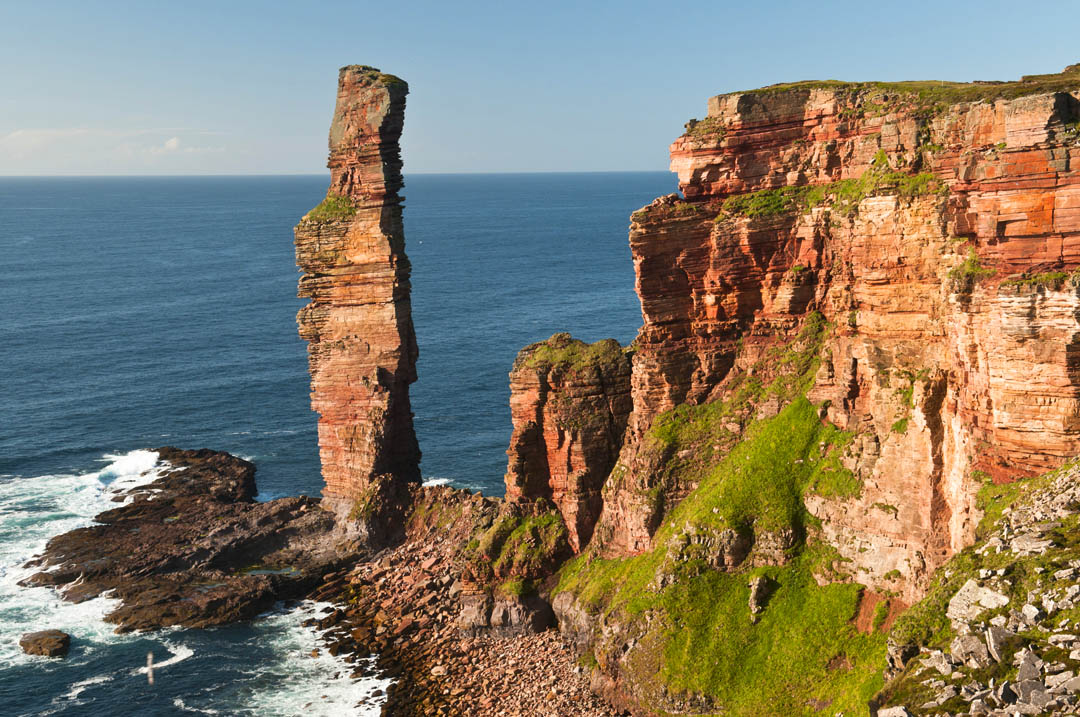
The Old Man of Hoy is the most iconic natural landmark of Orkney, arguably the tallest sea stack in the UK. The isle of Hoy is best accessed by boat from Stromness (to Moaness), and is small enough to be explored by foot, however it may take more than 1 day!
Hoy is a unique island for a couple of reasons. Firstly, the only hills of Orkney archipelago are located on Hoy; secondly, the northernmost natural woodland in the UK is hidden in one of Hoy’s glens; thirdly, the Old Man of Hoy, the tallest sea stack in the UK is only a short walk from Rackwick, at the western tip of Hoy. And last but not least, Dwarfie Stane, the prehistoric burial site, a hollowed monolith, as well as the famous pebbles of Rackwick beach (usually photographed at twilight)
We recommend exploring Hoy by foot, over a 2 day hiking adventure including a climb to Cuilags, visit to St. John’s Head (the highest cliffs in the UK!), a secret seabird colony, the Old Man of Hoy, Rackwick and Dwarfie Stane.
Follow our footsteps of the amazing 2 day hike on Hoy, the ultimate Orcadian hiking adventure!

DAY 6, return from Hoy, Round Kirk, Earl’s Bu & Orkneyinga Saga, Skara Brae
As we mentioned above, we recommend visiting Hoy over 2 days, we even provided a detailed guide on a fine 2 day hike to the Old Man of Hoy, via Cuilags and St. John’s Head. Hence morning of the day 6 of Orkney itinerary is reserved for the return from Hoy and crossing Moaness – Stromness. We strongly encourage you to spend the remining part of the day to see the ‘Round Kirk’ and Earl’s Bu near Orphir and learn about Orkneyinga Saga, then later moving forward to explore Skara Brae, the most important Neolithic site of Orkney!
The legend says that Earl’s Bu and Round Kirk at Orphir are the making of Haakon Paulsson, the earl of Orkney (1103-1123), the very same person who was responsible for death and martyrdom of St. Magnus (the saint patron of Kirkwall cathedral). It is believed that the Round Kirk was built as a penance for Magnus Erlendsson’s death. Incredible how the stories are entangled!
Sadly, nowadays only a tiny part of the Round Kirk remains, but its location is also mentioned in Orkneyinga Saga that names the very same spot as a place of Earl’s Bu, a Viking times Great Drinking Hall. Local visitors centre offers in depth insight into the story as well as a wide range of Viking legends and mythology (another great idea for a gift from Orkney! I admit, I gave in and got myself a brick of a book on Viking legends as a present from Orkney to myself, apart from a 10 yo Highland Park whisky, of course!)

Skara Brae is by far the most famous Neolithic site in Orkney, in fact it’s world-famous, being a UNESCO World Heritage Site! The Neolithic village is located at the beach near Skaill, in the western part of Orkney mainland. This makes Skara Brae easily accessible and well connected by public transport!
The village was first discovered in 19th century, and local landlord conducted a small excavation, finding an outline of a couple of dwellings. Later, a massive storm hit the shores of Skaill Bay, damaging the excavated dwellings and at the same time unearthing other structures. What we see nowadays is a result of many years of meticulous and careful excavating of the grounds.
The settlement consists of 8 clusters of Neolithic homes, connected by passages and corridors, occupied between 3200 BC and 2500BC. It is still unclear why the community abandoned the village. What we know for sure today is that Skara Brae is much older than the Great Pyramids of Egypt, or Stonehenge, and is often referred to as Scottish Pompei, as it’s preserved just as excellently! Skara Brae is considered one of the most important prehistoric landmarks in Europe!
The village proves that Neolithic builders were advanced to some extend, as the settlement was designed and built far from ‘randomly’. To shelter from harsh Scottish wintry weather, the dwellings were constructed partially underground, with covered corridors and passages, but the most significant discovery was finding a web of under-house drainage system! Neolithic community of Skara Brae was far from primitive!

Don’t hesitate to visit the most extraordinary village on Orkney, and learn more about early life on the islands. We guarantee that your time as Skara Brae will be unforgettable!
You can visit Skara Brae any time of the year, however winter opening hours are shorter. It is best to book your visit in advance, and if possible joining a guided tour!
During our visit to Skara Brae we were rather lucky, despite arriving late in the day we were still admitted to the village, even more, at closing time a warden/guide lady gave us a short tour of dwellings otherwise inaccessible to public. It was then, we learnt about the advanced drainage system under the settlement!

DAY 7, finishing off the epic Orkney road trip with visits to Brough of Birsay, Broch of Gurness and Yesnaby castle!
The last day of the Orkney itinerary is dedicated to explore a couple more historic sites, with a surprise visit to Orkney’s amazing castle at Yesnaby!
BROUGH OF BIRSAY
First things first, why not start a day by exploring Brough of Birsay, a tidal island at the western end of Orkney mainland. Birsay was under rule of Scottish Pictish community who were later dominated by Vikings. The island is home to remains of a fort, where scientists found pins, brooches and rings dating back to Pictish and Viking rule, with later Medieval influence. When the Norse colonised Birsay, they built dwellings, barns and even a sauna! The remains of these are still to be seen on the island!
Birsay is a small island, perfect for a short walk, on top of historical attractions it also offers lovely peaceful walks with stunning seaviews, its cliffs are home to large seabird colony (mostly fulmars and guillemots). Island’s relaxed ambience and gulls cry encourage finding a quiet spot at the cliffs at the far end, to go over Orkney’s dramatic and surprising history and influences!

BROCH OF GURNESS
Broch of Gurness can be found at the northern end of Orkney mainland, but it’ well worth the additional drive! This Iron Age complex contained a village of approximately 14 houses built around the broch, the outlines and ruins of them can be seen today. Similarly to Skara Brae, the dwellings were partially built underground, at the bottom of a ditch. Houses were accessed from a passage that run in circle around the broch, had no windows and were covered by turf or thached roof. A screen of upbuilt flagstones defined a living area of each dwelling, with heath, sleeping chambers and cupboards. Also a watertight tank which is believed to serve as fishing bait storage. So again, far from primitive, quite contrary, a rather well thought thru and practical.

YESNABY CASTLE
Yesnaby castle is unlike any other Scottish castle! If you expect to see ruined walls and towers you’ll be utterly surprised! Yesnaby castle is an amazing two-legged sea stack, which can be seen along the rocky cliffs of western mainland! Getting to Yesnaby castle involves a pleasant coastal walk with view to skerries, sea caves, natural arches, and finally the beautiful sea stack! Although the visit takes only 2-3 hours it is a highlight of the last day of 7 day Orkney Itinerary!
The coastal walk to Yesnaby castle starts from a dedicated car park at the old military road, nowadays an access road to numerous farms, hence look out for livestock while driving along!

Although the coastal trail is unmarked you won’t have any trouble to find your way, simply follow the path along clifftop, to your left (west-south). On a clear day you will be able to see silhouettes of stunning cliffs of St. John’s Head on Hoy! But, these are not too important now, as you’ve already seen them up close during a hike to the Old Man of Hoy, the other day. Today, focus of coastal delights of Yesnaby cliffs, with dramatic drops and rocky sea bed, hidden sea caves. Ensure to be careful when approaching the cliff edge, no photo is worth more than your health and safety. Having said that we strongly encourage you to explore the coast of Yesnaby and assure you that as you’ll follow the clifftop path you’ll come to numerous viewpoints and discover interesting coastal features, for example small hidden bays, high passages from the land to rock towers (like on the photos above). If you have good head for heights you may be tempted to cross to the rock towers, over narrow passages high over the sea, but be aware of strong winds at Yesnaby coast, that could make the experience dangerous!
Don’t be tempted to turn back as soon as you see the amazing Yesnaby castle, the best viewpoint to the sea stack is located further along the coast, some 200-300 metres past the stack! It’s well worth the additional 5 mins walk!
To recap the coastal walk to Yesnaby castle viewpoint is approximately 3-4 km (there and back), easy clifftop path, mostly flat, we recommend allocating 2-3 hours to explore the coast. Ensure to dress properly for the hike, as the trail can be quite windy!
Accommodation in Orkney
We handpicked several great accommodation options especially for you! Browse them below:
| Accommodation | Location | Rating | Comment |
| The Sands Hotel | Burray | 9.1 /10 | Very friendly, helpful, and attentive staff. Comfortable and Well-Appointed Rooms. High-Quality Dining Experience. |
| Taylor’s Rest | Tankerness | 9.8 /10 | The house offers 3 bedrooms and a bathroom. Cosy (with a fire place) and well located. |
| Royal Oak Guesthouse | Kirkwall | 9.3 /10 | Option for those who love B&B. Nice bedrooms with ensuite bathrooms and well-prised breakfast. |
| Lochview | Evie | 9.6 /10 | A specious apartment with private entrance and garden with a fantastic view. Fully equipped kitchen. |
WE’RE SURE YOU’LL LOVE YOUR ROAD TRIP TO ORKNEY!
MAKE SURE TO GET IN TOUCH WHEN YOU’RE BACK, WE LOOK FORWARD TO HEARING ALL ABOUT YOUR FAVOURITE ATTRACTIONS AND EXPERIENCES!
